The rain continued on and off throughout the night with the odd flash of lightning and distant rumble of thunder for good measure. There is something particularly wonderful about being so close to the elements during a storm and yet protected from them. Listening to the rain drumming on the roof from the cosy safety of bed is one of the things I like best about van life. Even better is when the morning dawns bright and sunny as it did this morning. The breeze had got up and chased the clouds out to sea. It was a brisk start. The sound of the waves rolling onto the stony beach joined with the wind in the leaves above us to make a noise not unlike the hum of a big crowd. Through the trees, beyond the harbour wall, we could see the white horses forming the crests of the waves. Smoke streamed from the funnel of the pineapple carrier which was preparing to slip its moorings. The birds were singing loudly and flitting between the trees and the ground, foraging in the dead leaves for their breakfast. Everything was saying it was time to get up. This was not a morning for staying in bed.
We soon had all our chattels securely stowed for the mountain roads. The waste tanks were emptied and the fresh water replenished. The lockers and hatches were secured and double checked. I released the handbrake, pressed the accelerator and Vera climbed steadily up the steep curve of road out of Port Vendres. A quick ring of the bell confirmed we were off again. The drive today would be mostly climbing and hairpin bends. Vera seemed up for the challenge, pulling powerfully up the steep gradients and sticking reassuringly to the road round the tight bends. This was the kind of driving I liked best and we settled down for the two hours of mountain scenery between here and Casteil.
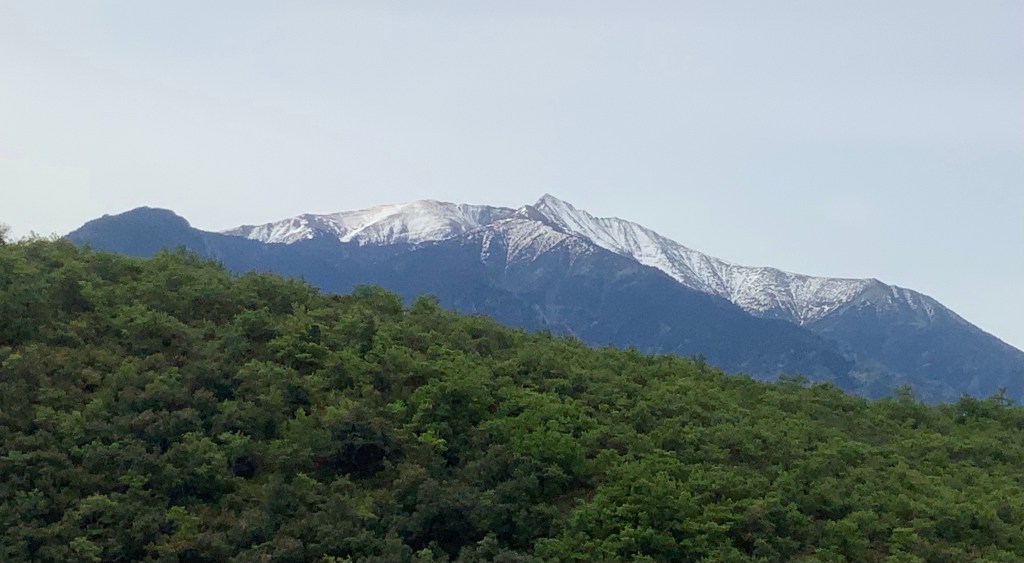
Casteil is a small village at the end of a valley. There really isn’t anything but mountains beyond it and the only reason to go is to visit the monastery of Saint Martin de Canigou. We found an idyllic spot to park, next to a mountain stream and just a short walk from the village. It was now getting a little late to go up to the monastery and our legs were still feeling the effects of yesterday’s walk. We set up our deckchairs and settled down for a quiet afternoon of reading and sunbathing. At this height the air was clear and we could feel the sun burning into our skin. A robin carried on with his daily chores without seeming to mind too much that we were there. Stopping occasionally to look at us with his bright bead of an eye, he hopped about busily. Insects buzzed and fluttered in the air and as the sun moved round, the light filtered through the leaves of the trees and we found ourselves partly shaded by the dappled light. After the vibrancy of the seaside, this felt very calming and I could feel my eyelids growing heavy. Not wanting to fall asleep we decided to walk up into the village.
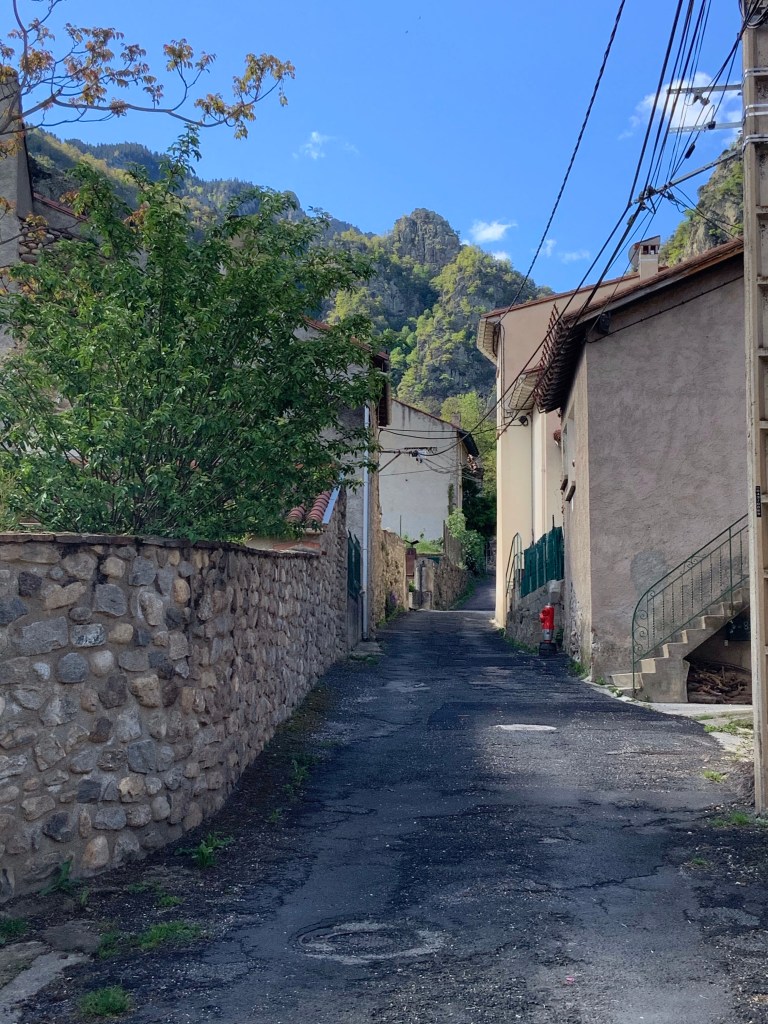
It was obvious that in this isolated village there was a strong local community. A lovely area had been reserved for village gatherings with long tables and benches and a big barbecue under the trees with room for dancing in the middle. I could picture the ‘bal de village’ on a summer’s evening with lights strung between the trees, a little band playing, people dancing and a coil of sausage grilling over the embers. I was certain my reverie was not far from the truth.
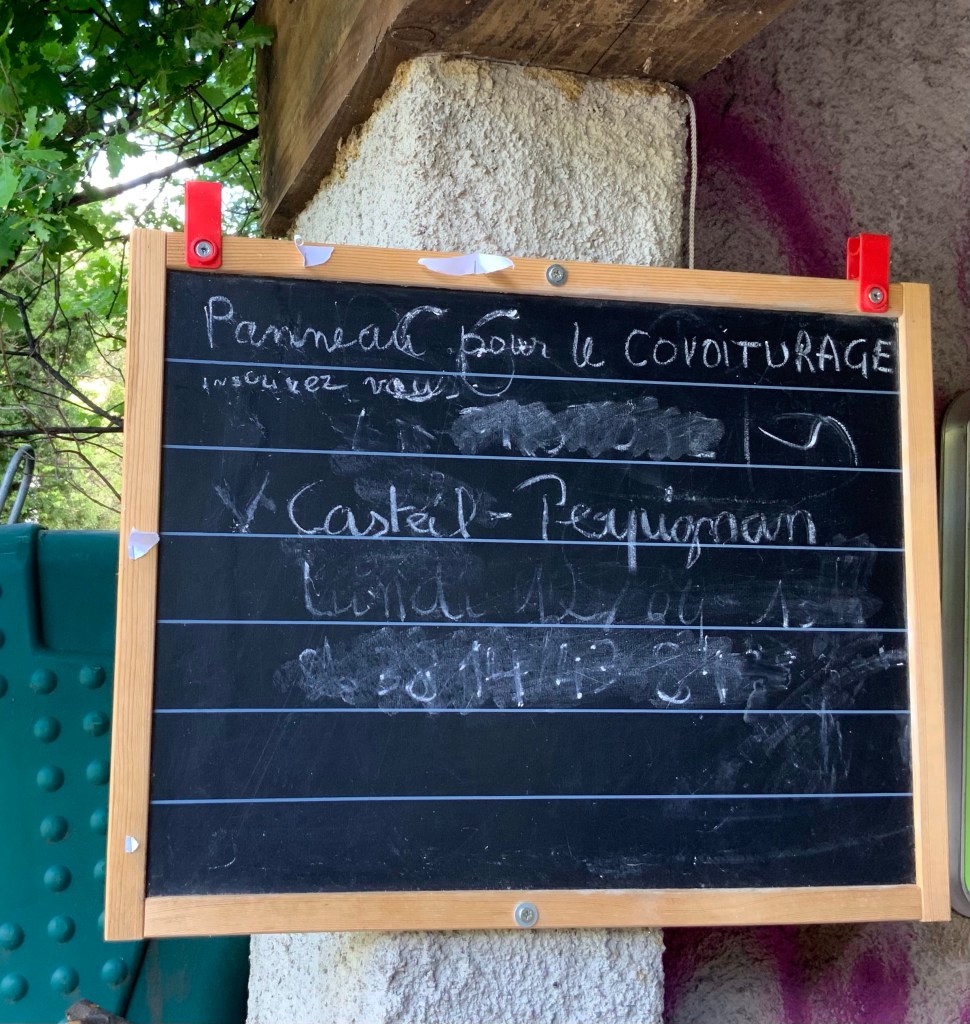
Hanging on a lamp post by the bus stop was a blackboard where people could sign up for car sharing and write down the car journeys they were planning. In a remote community with high fuel charges this would surely be a lifeline for some people as well as being better for the environment and a way of keeping the villagers in touch with each other.
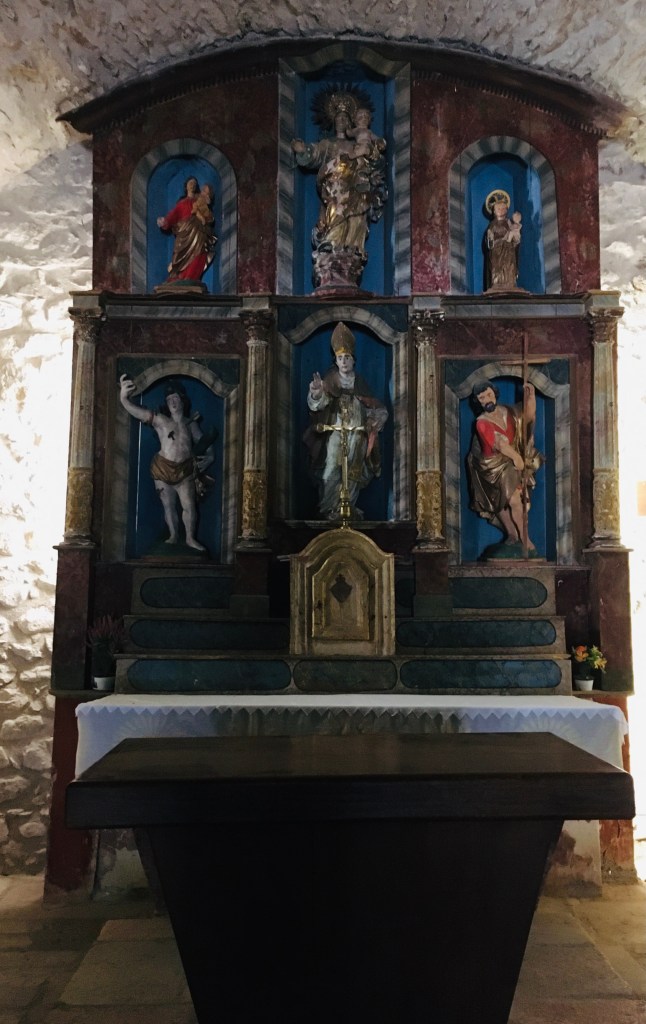
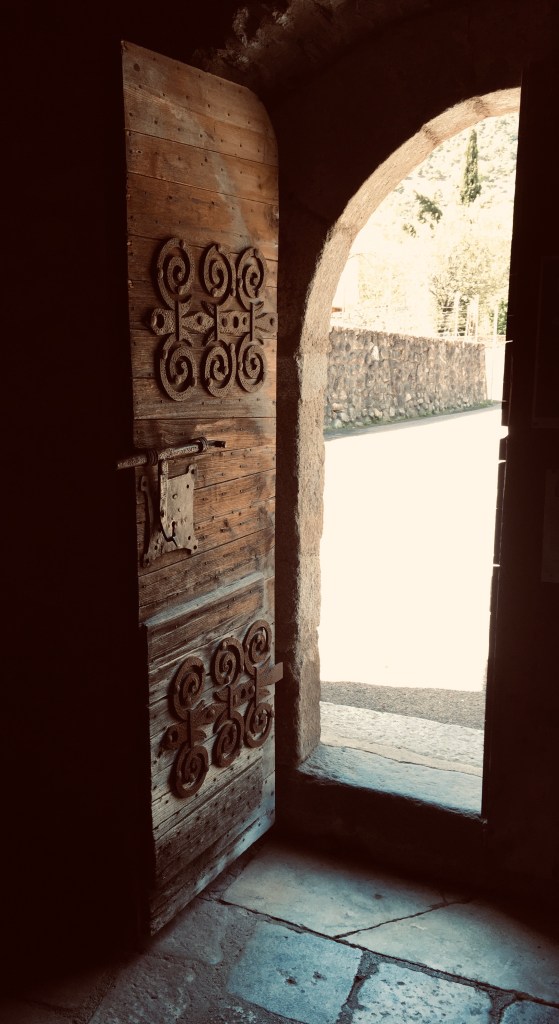
We found the start of the path to the monastery behind a little chapel. The door was open and in the gloom of the interior I could just discern a beautiful altarpiece. It was cool inside and we sat for a moment. I was now in a contemplative mood and started to think about the walk up to the monastery in the morning. I thought about the monks three hundred metres (980 feet) above us and the villagers here in the valley. Both groups were living in strong, supportive communities. How many people were now living in towns and cities with little or no sense of community, completely isolated from their neighbours and extended families? Whenever I visit remote villages, I’m always impressed by how close knit and supportive they appear to be. I can’t help thinking that rebuilding functioning communities is the answer to many of the problems facing 21st century society. Perhaps, contained in the history of the buildings above us was a message of hope for the future. Saint Martin de Canigou was founded in 1009 by Guifred (spellings vary), Count of Cerdanya. The Benedictine order remained until 1783 when the monks left. The buildings then fell into disrepair, were further looted and damaged during the French Revolution and subsequently were used as a stone quarry. At the beginning of the 20th century the Catalan Bishop of Elbe and Perpignan began the restoration of the buildings. Today the Abbey church is once again the beating heart of a thriving community of monks.
I have long been fascinated by monastic communities and the role they played in the development of western civilisation and culture. From the early Middle Ages monasteries were powerful centres of learning. Through the copying of classical texts monks became familiar with disciplines such as science and philosophy. Their resulting knowledge would in turn spawn new ideas and texts so that monasteries also contributed to new thinking and were certainly not just limited to religious study. Medical practice was also extremely important. The obligation to care for the sick meant the study of medical texts was widespread and there is evidence there was a very high degree of medical expertise.
In time these religious centres would be responsible for the education of the aristocracy and at the end of the 12th and beginning of the 13th centuries would evolve into what we now recognise as universities.
Well established, stable and often very wealthy foundations required labour and it was not unusual for villages and even towns to grow up around a monastic site. The most obvious example is the city of Munich which was established near a Benedictine monastery. Its German name, München, comes from a high German word meaning “ by the monks.”
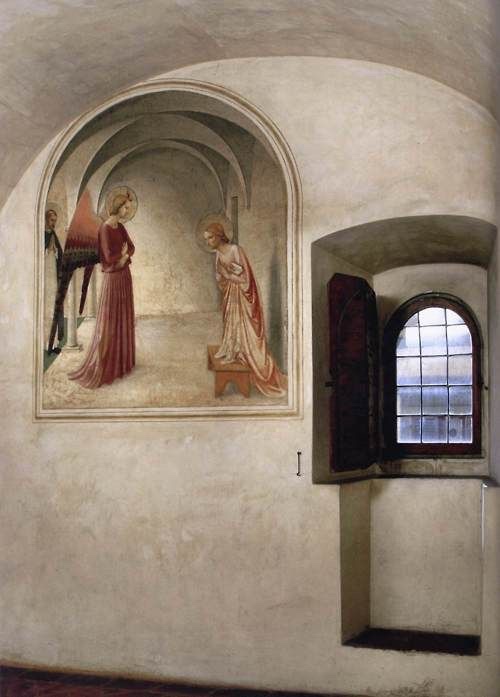
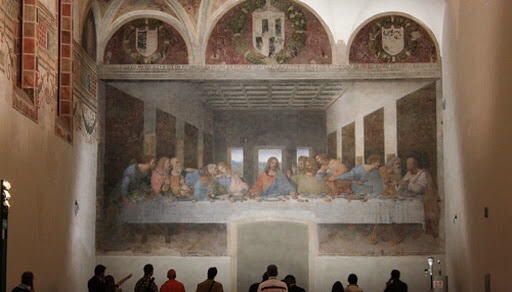
Religious houses also supported the arts and many of the greatest works of western art were created in or commissioned by them. One immediately thinks of the illuminated manuscripts such as the Book of Kells or the Lindisfarne Gospels but many monastery walls are decorated with frescoes and paintings. Probably the best known example is Leonardo da Vinci’s Last Supper in the Refectory of the Dominican convent of Santa Maria delle Grazie in Milan. My own favourites are the Frescoes by Fra Angelico which decorate the monks’ cells in the friary of San Marco in Florence.
Often monastic communities developed in remote places which were propitious for a life of prayer and religious contemplation. The buildings were constructed to glorify God and represented the spiritual life they contained. With the success and spread of the Benedictine order, many monasteries were built at the end of the 10th century and right through the 11th century. These buildings in the Romanesque style follow a similar pattern: a central cloister and garden with an adjoining church and refectory; work rooms and dormitories. Typically these 11th century buildings have beautifully carved capitals and decorated arches. Together with the simple and dignified sculptures, they imbue the buildings with a sense of calm and peace and make them works of art in their own right. Mont St Michel, Cluny, Fountains Abbey, the monasteries of Meteora in Greece, Melk in Austria, to name but a few, had all made huge impressions on me and for many different reasons. Back outside the chapel, in the bright sunshine, I was certain that Saint Martin de Canigou would join this auspicious list and leave its own unique imprint.
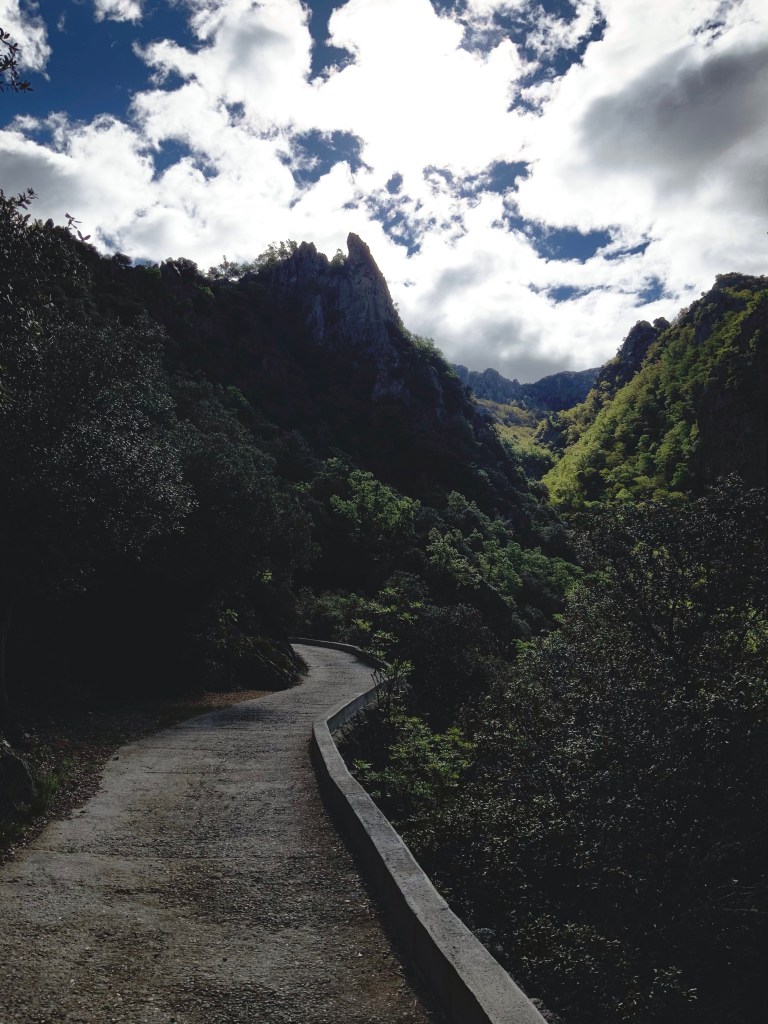
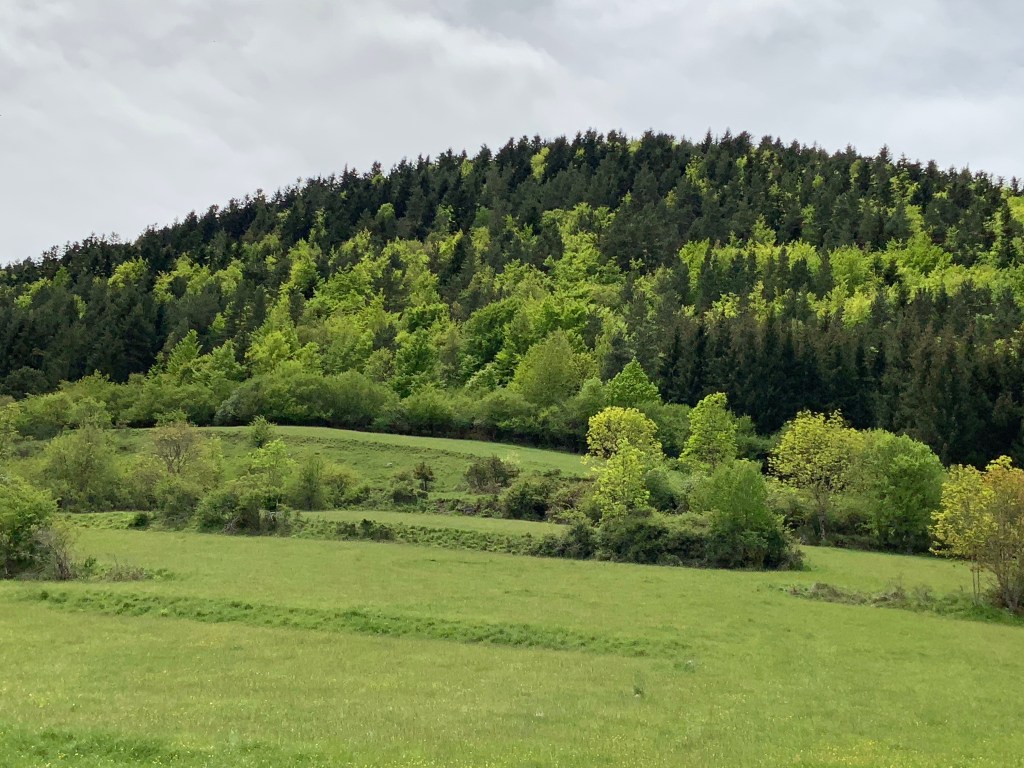
We awoke the next morning to the sound of birds and took our time getting ready. In contrast to the hustle and bustle of the seaside port this woodland glade was calm and peaceful. The sun was already finding its way through the trees to the valley floor when I shouldered the rucksack and we set off back into the village to make our way up the steep path to the monastery of St Martin de Canigou. All was quiet and the streets of the village were still empty. A dog looked up from his resting place in a doorway but decided we weren’t worth the effort and flopped back down without barking. Finding a steady, unhurried rhythm we started up the path. Because there is still a community of monks at Saint Martin de Canigou, the path up is paved allowing vehicles to reach it. The way is steep but not difficult and as we ascended, the view opened up. It was breathtaking. The slopes of the mountains were covered in contrasting greens, almost black where there were conifers and vibrant lime green where the leaves of the deciduous trees were bursting into new life. If we turned round we could see down the valley, over the roofs of Casteil, to Vernet les Bains and beyond.
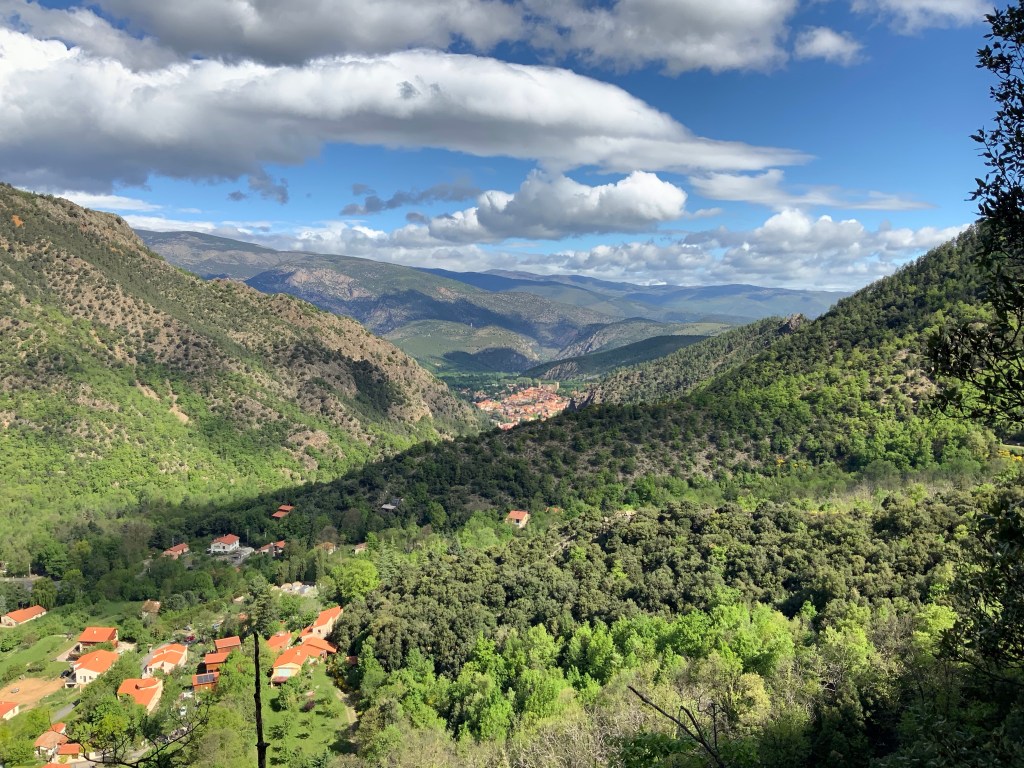
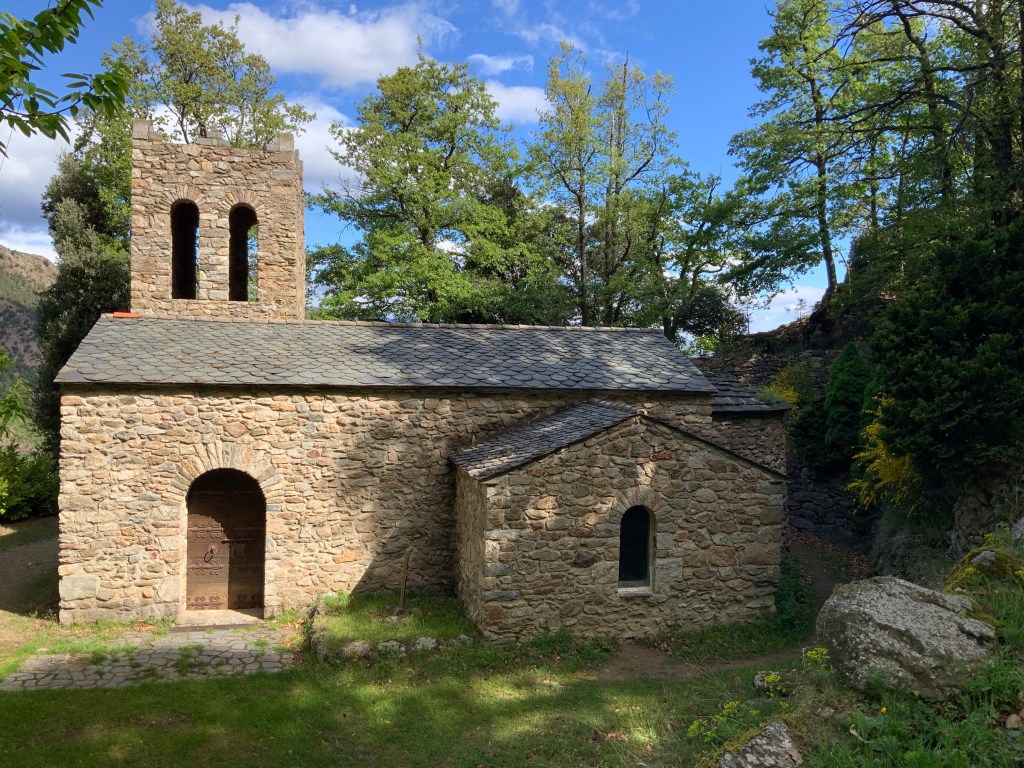
We carried on until we reached the church of Saint Martin-le-Vieux. The origins of this little church are unknown because there is no archival evidence. It’s likely it was built around 1000 and probably served as a funeral church for the monastery which, being built on a rocky outcrop, had nowhere for burials. The church was restored in the 1970s from the medieval ruins. We came down from the path and discovered a stupendous view from the far side of the church.
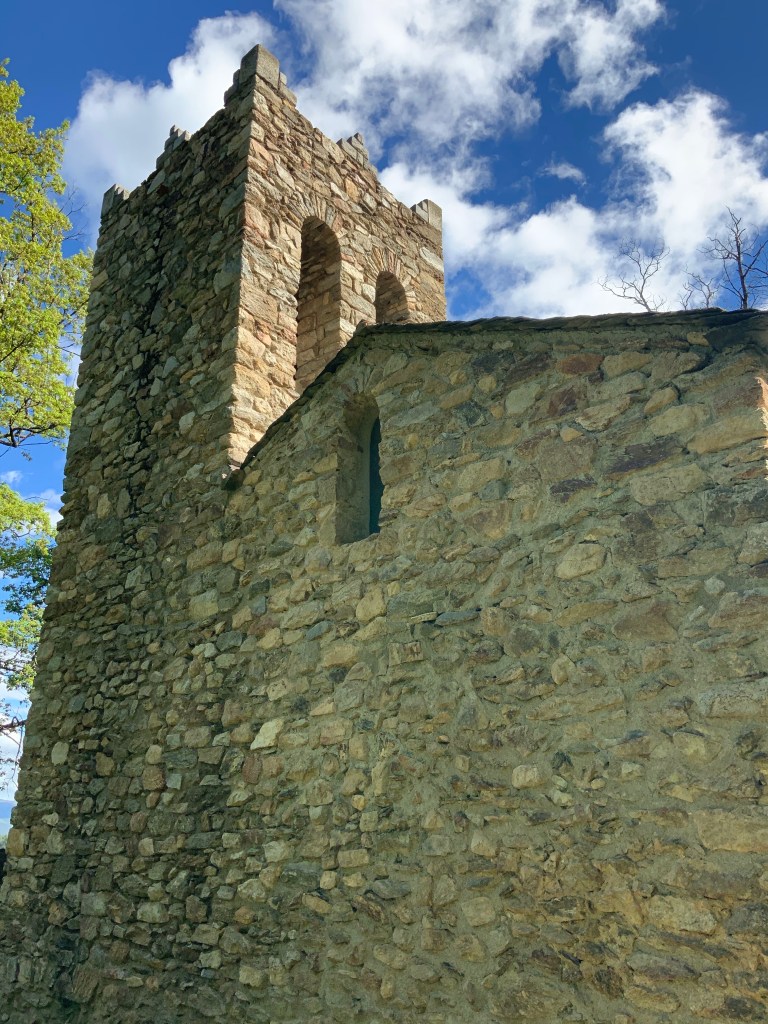
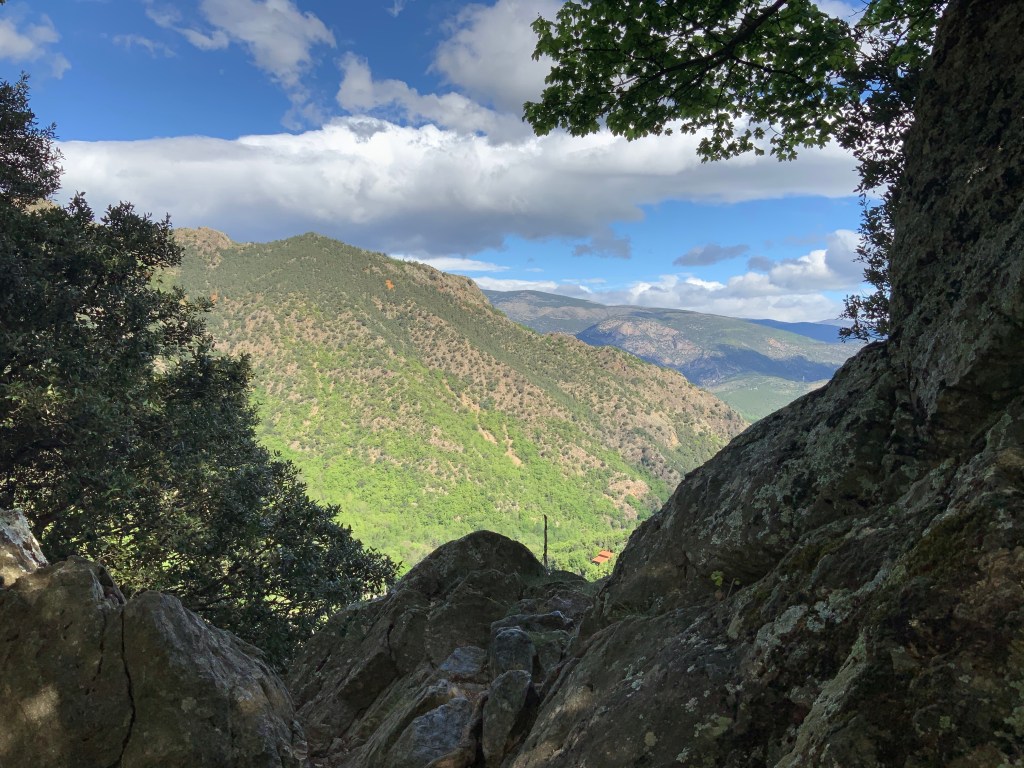
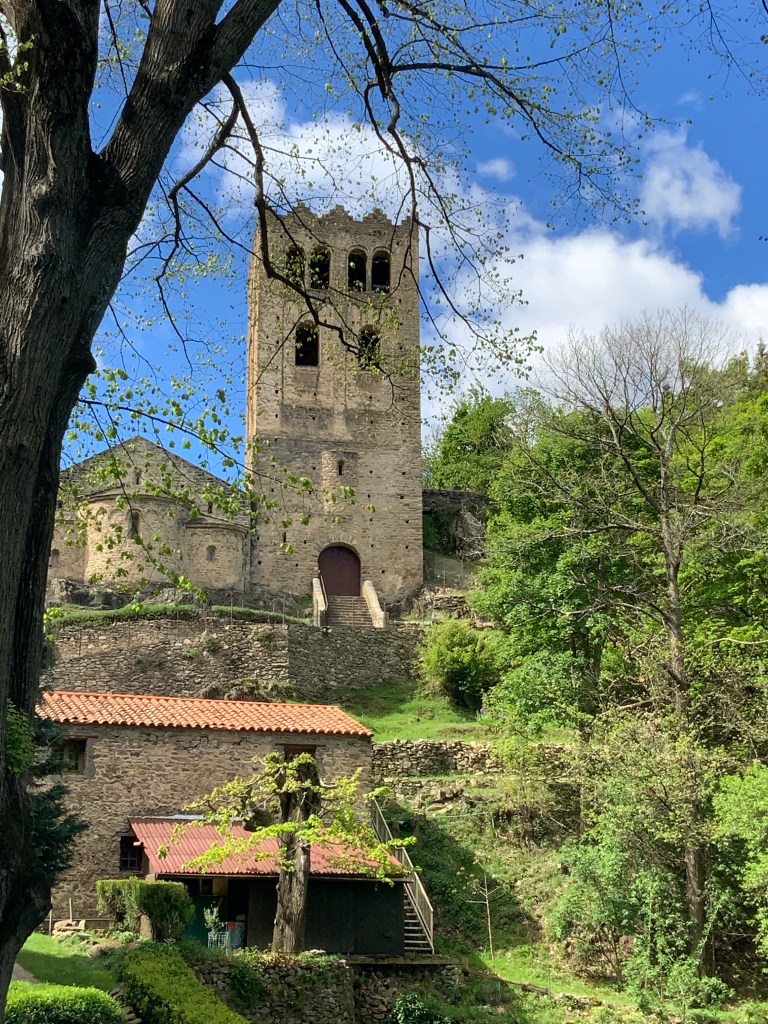
The path turned back on itself and continued onwards and upwards, and there, high above us, with just the sky for a backdrop was the Abbey church.
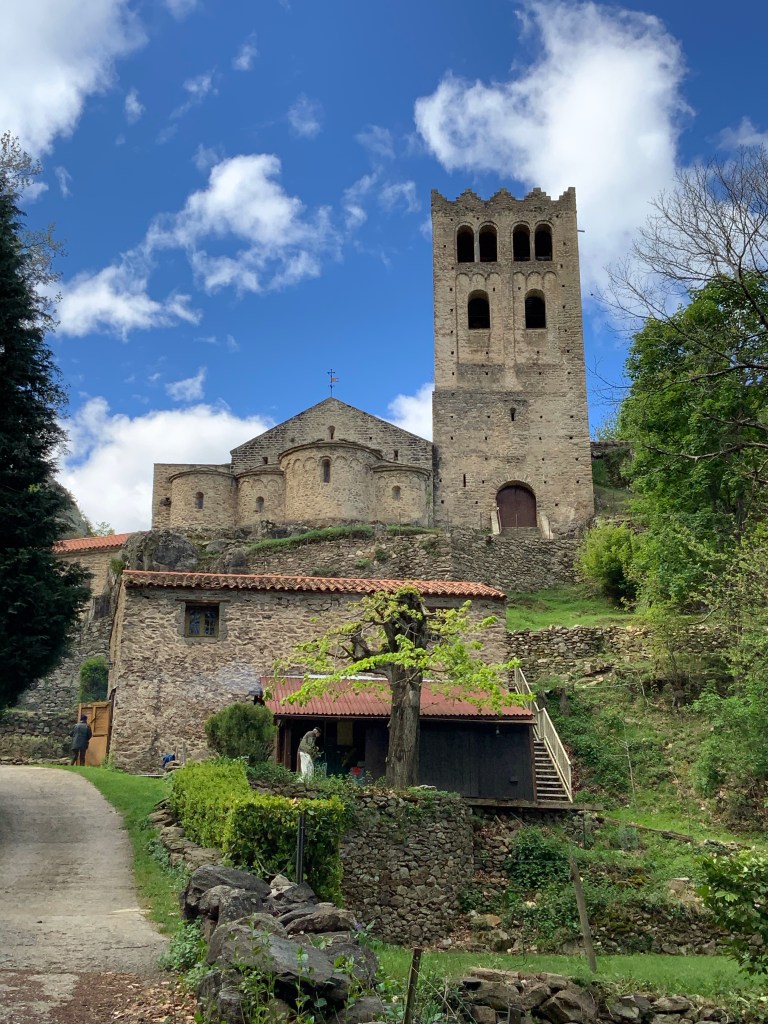
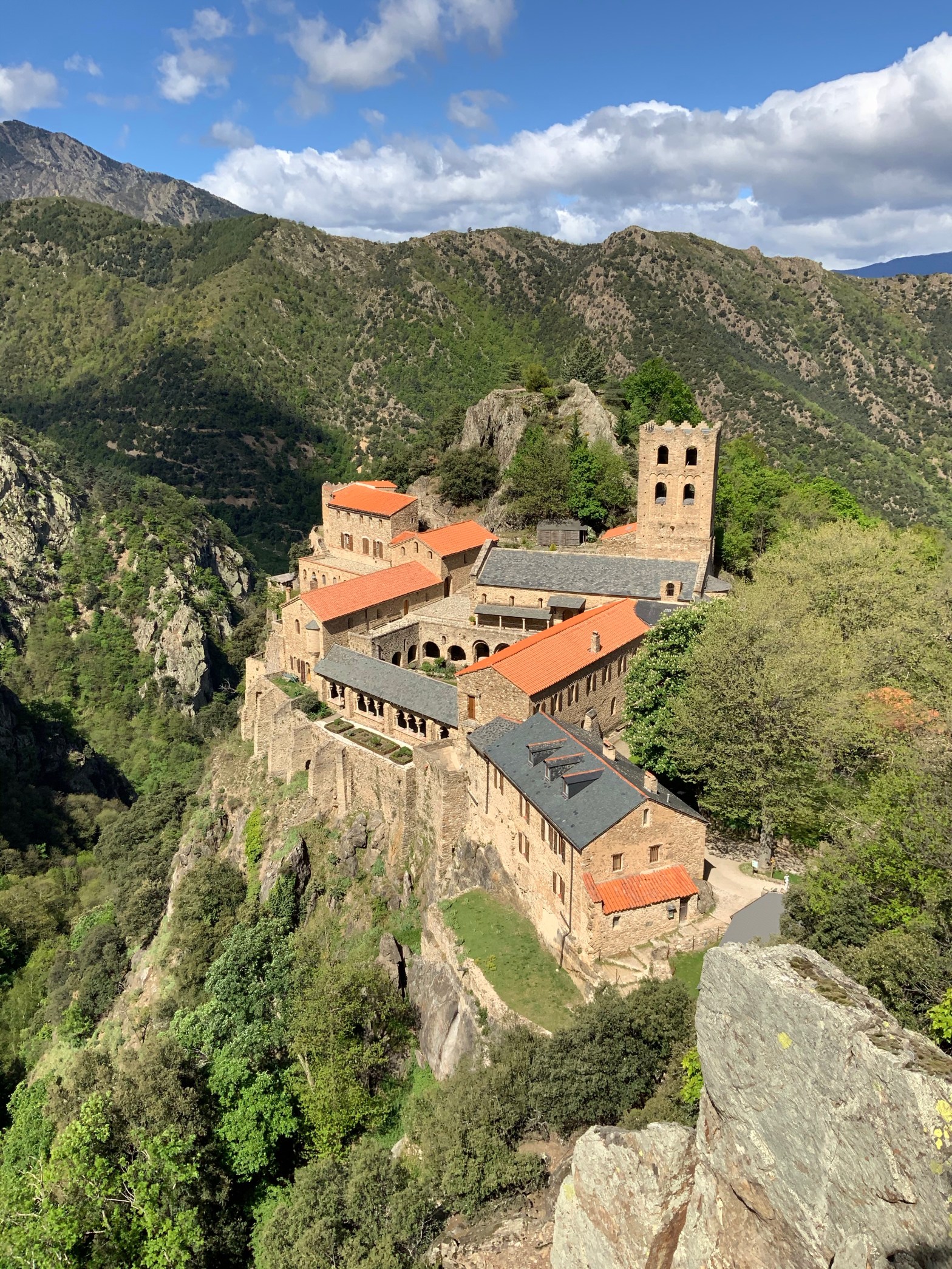
The rounded arches and apses blended harmoniously with the fortress-like walls to create an ensemble that appeared both delicate and mighty. The church seemed at the same time anchored to the mountain and floating in the heavens. Both of this world and the next. Here was another of those thin places. I wondered if the elderly brother working in the garden directly below the church felt it. We continued on in silence, up the path to view the abbey from above. Here we needed to climb and the paving gave way to a rough footpath. We scrambled onto a narrow platform from where we had a bird’s eye view of the entire complex.
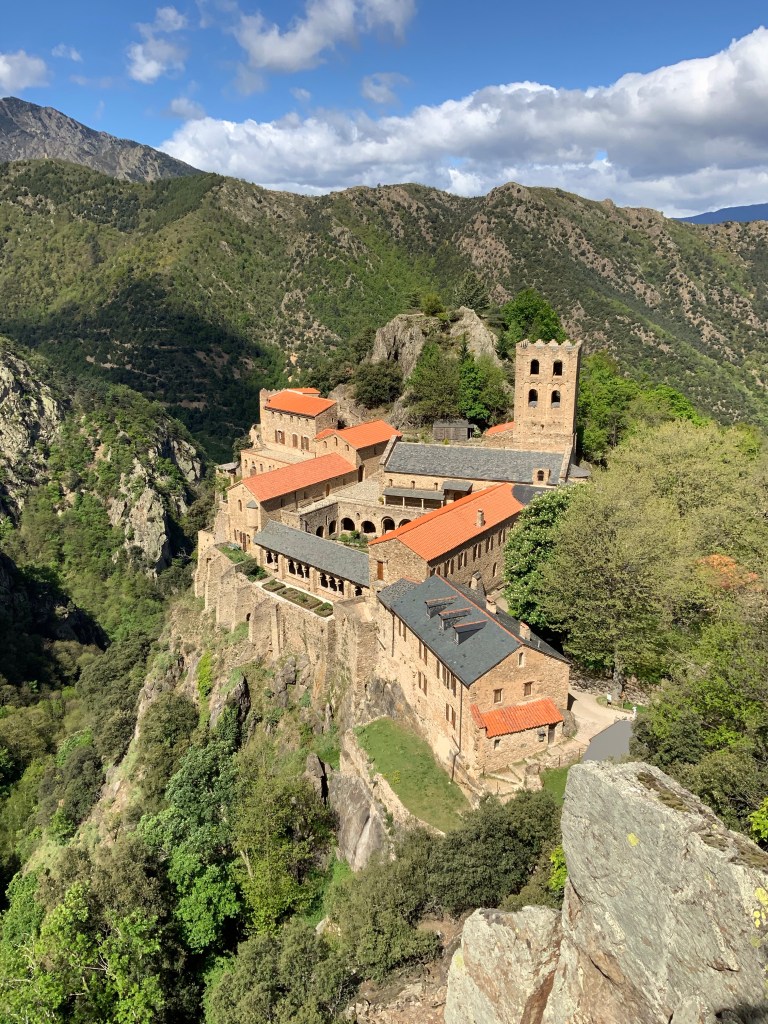
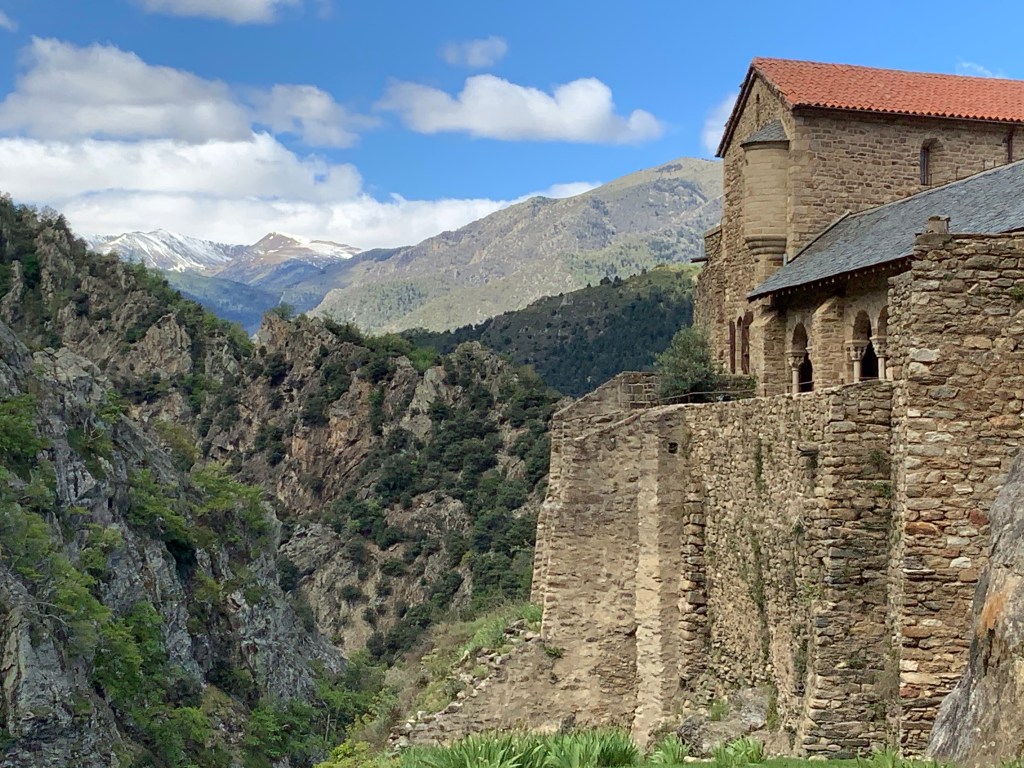
From this vantage point we could see down into the cloister and terraces. Every now and again robed figures moved around the building just as they had done for a thousand years.
View my other pages:
 john-lionet-here-there-and-everywhere.com
Again you brought delightful memories of past trips especially the climb to Meteora’s monasteries, Cappadocia and especially the night spent at Mont St Michel as you shared its history.
LikeLike
Thanks Paula. Hoping to see you very soon. Glad you’re enjoying the blog.
LikeLike
Such a wonderful read, it’s as if I was walking with your team.
LikeLiked by 1 person
Thanks CeCe. Hope to see you soon
LikeLike
Wonderful account of your trip! and the photo’s are amazing! Keep up the good work.xxxx
LikeLike
As enjoyable and interesting and informative as ever, John – I do hope you plan to publish these journals…..XX
LikeLiked by 1 person