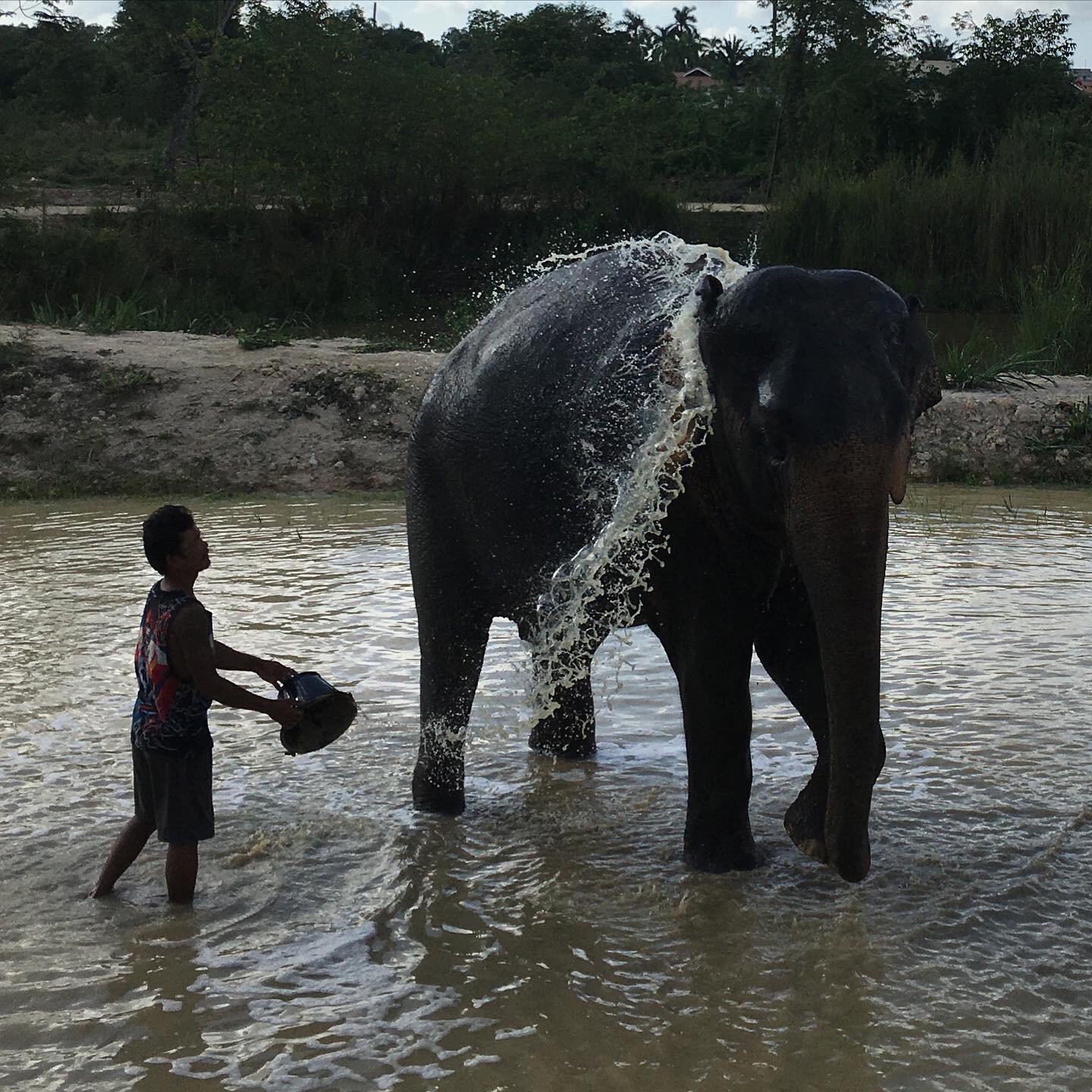
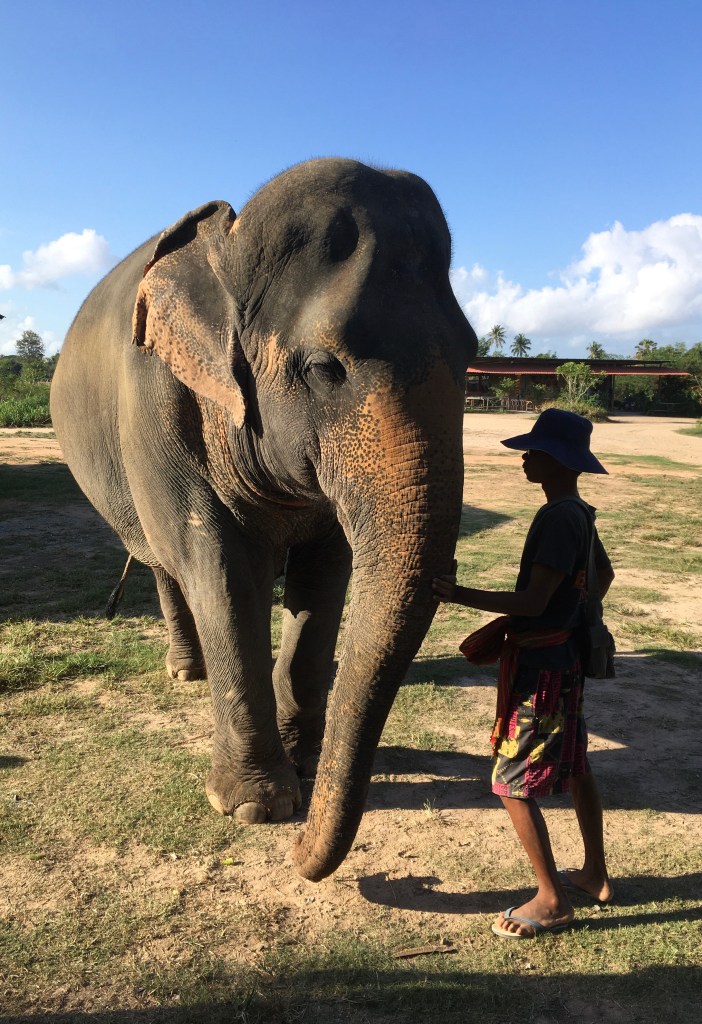
I made a friend today. She’s a few years older than me and has had a tough life working in the logging industry in Thailand. These days she’s retired but she still bears the emotional and physical scars of her working life. She’s blind in one eye and nearly blind in the other. A low life logger, trying to make her go faster, took a machete to her tail and chopped the end off. Because she’s an elephant she won’t forget and is still wary around humans she doesn’t know.
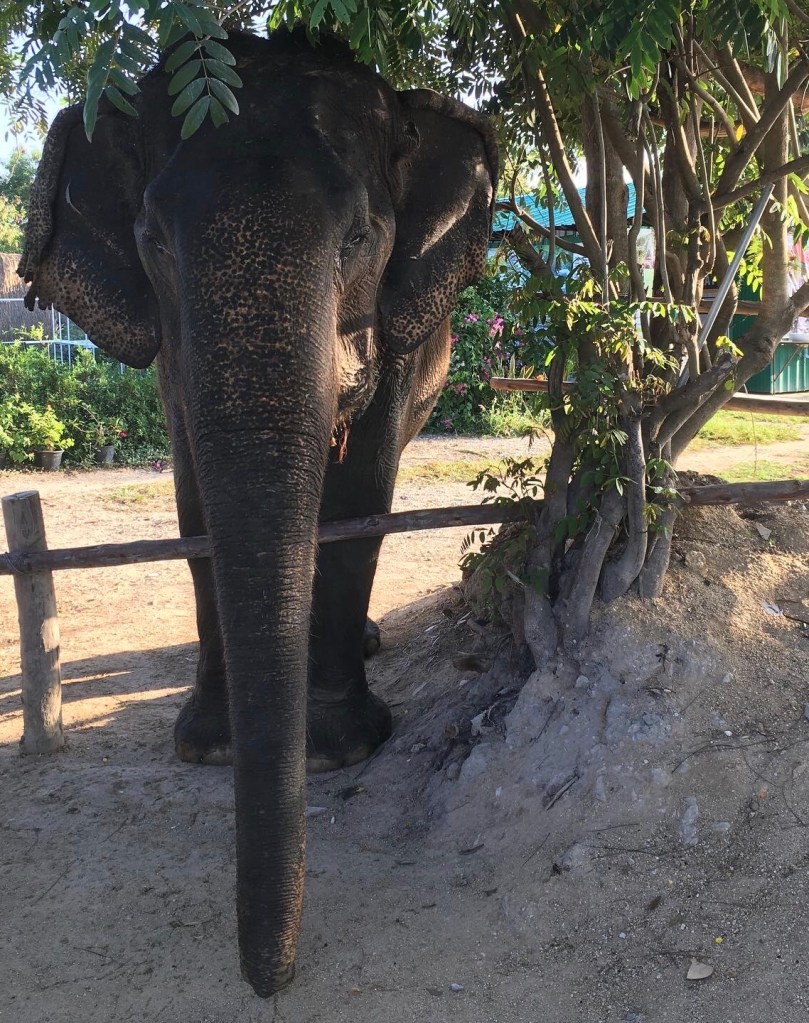
As I approached her slowly, bringing her a bunch of bananas, I knew I was about to meet a creature that would have a huge impact on me. Standing in the shade she sensed my arrival and tentatively started to search, with her trunk, for the food she knew I was bringing. I placed a banana on the end of her trunk and her finger wrapped around it firmly but very gently and she put it in her mouth. Immediately her trunk extended out again, much more confidently this time and I gave her another banana. She didn’t eat it but made a little crook in her trunk and deftly put the banana in it. The tip of her trunk came in search of another one and she put it with the first in the crook. Someone else held out a banana for her but she ignored them and she sought me out again and again. Each time she placed the banana in the crook until she had about ten of them. She obviously thought this was a suitable mouthful because she then put them all in her mouth at once. I was captivated. Firstly by her dexterity and secondly by the thoughtfulness of taking the fruits and waiting until she esteemed she had the right number to make a decent mouthful. I thought about the dogs at home. We’re often surprised by how “ intelligent” they are but they would never be able to think ahead like that. Each tit bit is devoured with no awareness that more may be coming and it might be nice to save them up for a better snacking experience!
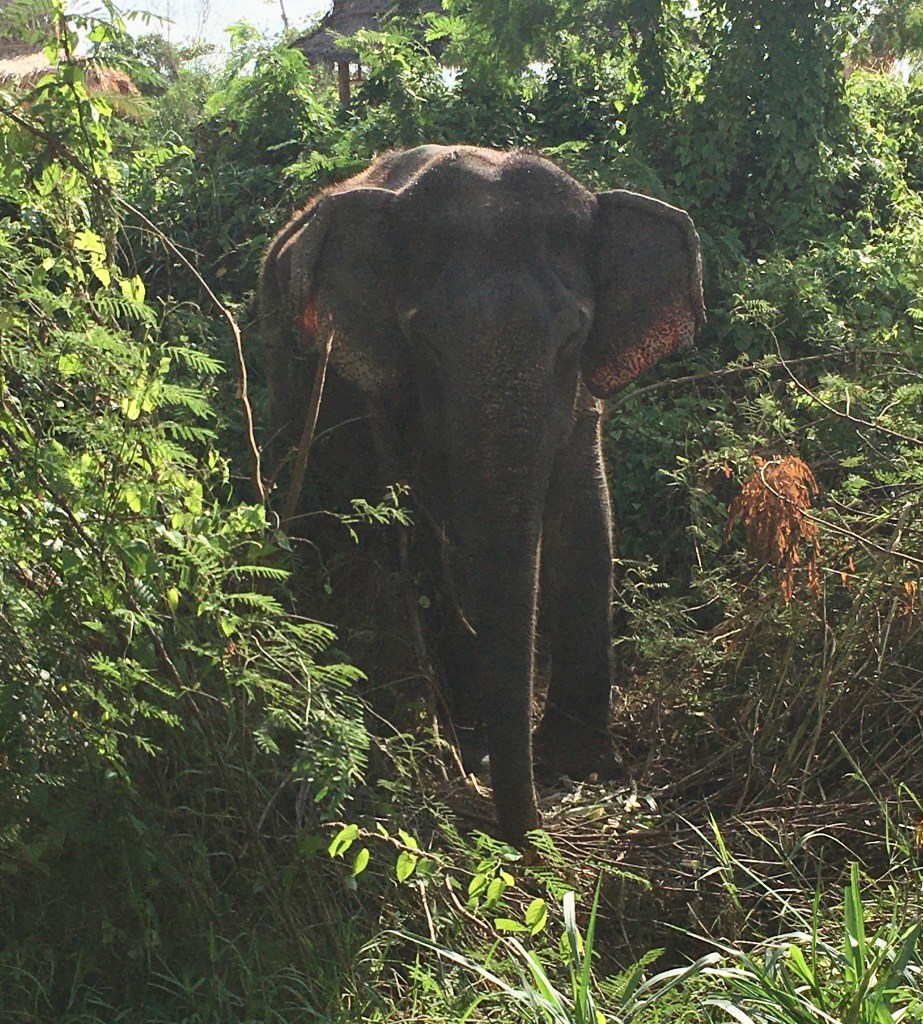
Although elephant brains are smaller, relative to their body size than human brains, they have the largest brain of any land mammal. Some areas of their brains are very highly developed. The large hippocampus gives them excellent memory and complex behaviours such as self recognition, cognition, the ability to express emotions and feelings, and elephants also have a perception of death.
My new friend was 58 years old, she had had a hard working life, had given birth, probably several times, had been badly treated by humans and forced to behave in ways that did not come naturally to her. Now she had been rescued and was retired in a sanctuary where she was safe, respected and never forced to to do anything that she didn’t want to do. She had a carer or mahout who kept her company and made sure she had what she needed but who never made unnatural demands on her.
Knowing that this creature had a long memory and was capable of thought and emotions, I wondered what was going on in that huge head. I looked into her better eye feeling a wave of empathy for this animal. Her trunk came towards me, this time not looking for food. I placed my hand gently on it and we stood like that for a minute. I hope she sensed the respect I had for her. I felt in that moment that she did. I wished that the rest of her life, perhaps another 20 years, would be uneventful and peaceful and that she wouldn’t be too troubled by the memories of her past. She shifted her great weight, picked up an enormous foot and turned, she was now free to make her own decisions, and wandered away in the direction of the waterhole. I would catch up with her later and help cover her in mud, a way of cooling her down and moisturising her skin.
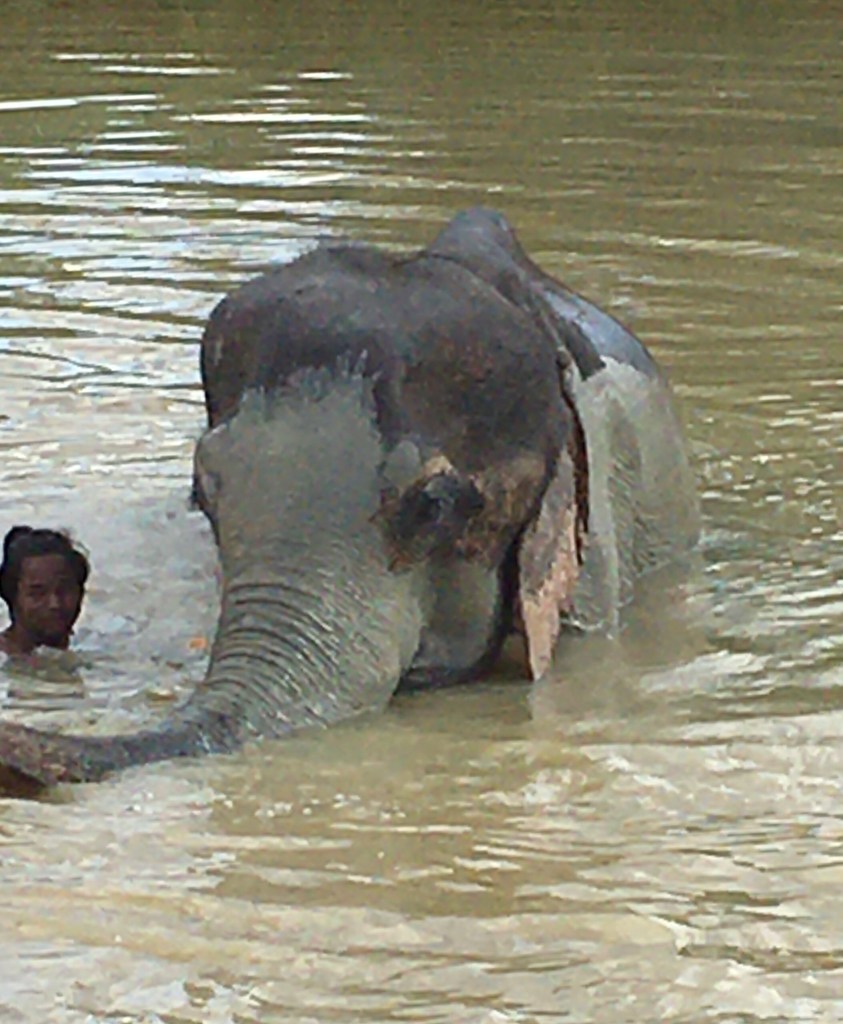
I watched her go, dutifully followed by her mahout. Mahout is a Hindi word that describes an elephant carer. It is considered a sacred profession. Because elephants are so intelligent they can form a very strong bond with their mahout. At the sanctuary, they are there to ensure the safety of the elephants and visitors. To that end they use empathy and thoughtfulness to train the elephants to keep everyone safe without compelling them to do anything unnatural. Because human and Asian elephant lifespans are similar, a mahout and an elephant are often paired early in life and spend their entire lives together.
With my friend gone, my attention was caught by a baby elephant. He was four years old and had he still been with his mother would not yet have been fully weened. He was just like a typical four year old. Lively and boisterous but in his quieter moments I noticed that he rocked from side to side. That didn’t seem like normal elephant behaviour to me and I questioned his mahout, just a boy himself, about it. He explained that this very young elephant (elephants experience puberty between the ages of twelve and twenty) had been rescued from a circus. In all likelihood he had been chained up for long periods of time and hadn’t received the stimulation he needed. The largest part of an elephant’s brain is the pre-frontal cortex which is responsible for processing emotional and social input. This baby elephant had been deprived of the emotional and social development that would have been given naturally in the herd. The swaying or rocking motion I had observed was typical of such animals as was nipple and tail tugging. This lively, boisterous, intelligent little elephant who was now starting to find his feet at the sanctuary was, nevertheless, emotionally damaged for the rest of his long life because humans like to watch other animals perform tricks.

Every elephant had its own story. Many elephants become too expensive to keep in old age when they require veterinary care and are no longer able to work. The sanctuary is increasingly confronted with the challenges and expense of geriatric care.
Another remarkable story was that of an elephant, now at the sanctuary, who had been used to give rides on the beach at Phuket. The day of the devastating tsunami, she had been giving an eight year old British girl a ride. When many humans were running towards the receding tide to pick up stranded fish, this elephant defied her trainer and ran inland with the girl on her back. When the water rushed back in they were gone. She had saved her own life and the girl’s. Elephants have hundreds of nerve endings in the soles of their feet and she had undoubtedly felt the vibrations of the coming tsunami. When I met this elephant, I was not surprised she had defied her trainer. She clearly had a feisty character. She was the only elephant I met who snatched the bananas and cucumbers out of my hand and appeared annoyed when there weren’t any more.
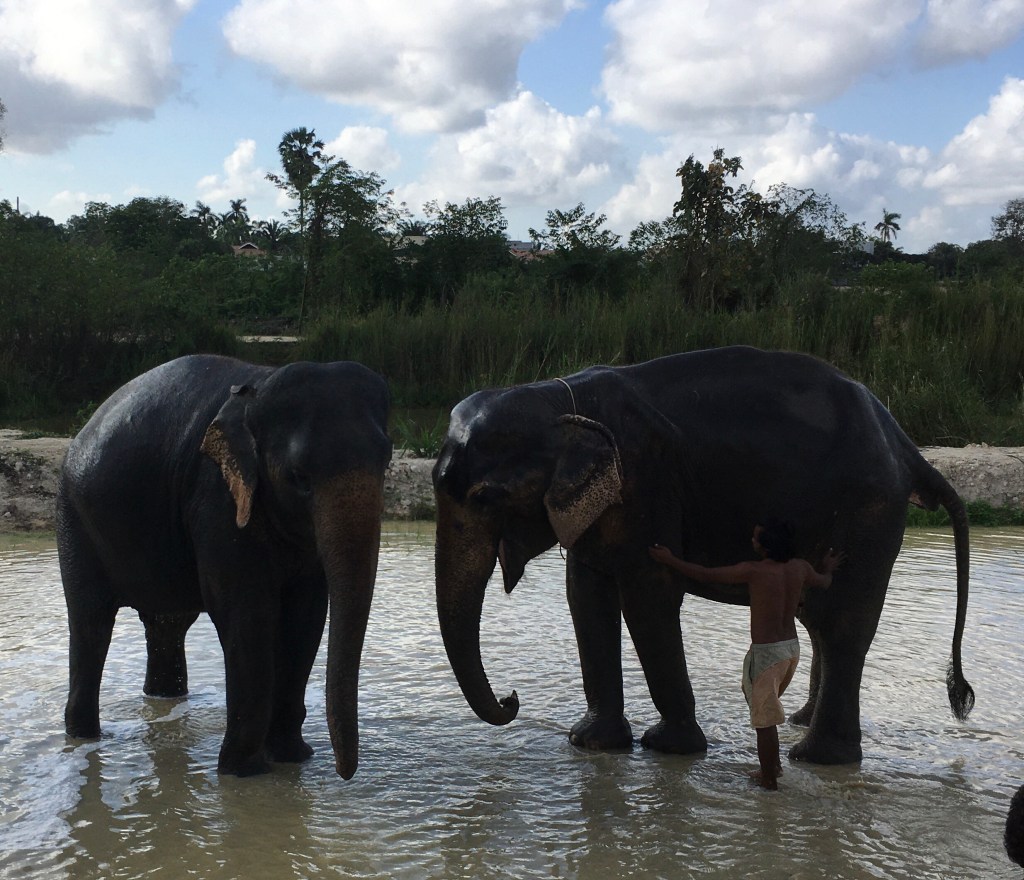
By now the elephants had mostly decided it was time for their mud bath. We followed them and got into the muddy water with them, smearing the mud over them and rubbing it into their skin. It was fun for the humans and the elephants were enjoying themselves too. I met my friend again. She was quieter than the others and had moved away from the other elephants and humans. This elephant had really had an effect on me and I stood and watched as her mahout gave her her beauty treatment. He saw me looking and signalled for me to go over. I waded through the sticky mud and together we finished the job. When she’d had enough she heaved herself up and using her trunk like a hand steadied herself as she climbed out of the mud bath. She crossed the track into the swimming pool where she filled her trunk with water and showered herself off. We helped her get clean scrubbing her with big brushes. She settled down in the water and let us go to work.

I was aware that the sanctuary needed to raise money and that the feeding, the mud bath and swimming were activities for the human visitors and I worried that even here the elephants were being exploited. I mentioned this to one of the educators at the sanctuary and was reassured that the elephants had not been forced to do anything. We had just followed them in their daily routine at the sanctuary where the habits of wild elephants are copied as closely as possible. The elephants had always been treated with the utmost respect and the need for that had been stressed to the visitors from the beginning. The work of the sanctuary is costly and goes beyond the daily care of the elephants. They run education projects and work with local communities to foster a better understanding in order to reduce human-elephant conflict. Their projects include infrastructure development, clean up operations, school scholarships, geriatric elephant care, mahout education and the construction of elephant veterinary clinics. All of this is necessary, there are approximately 3,500 wild elephants in Thailandand and 3,500-4,000 captive or domestic elephants.
The morning passed all too quickly and before we knew it it was time to say goodbye to the elephants. There were more bananas and cucumbers. Elephants are always hungry they need to eat about 200-300kg of food and drink about 40 litres of water per day. No wonder wild elephants come into conflict with farming communities.
I picked up more bananas and cucumbers. I knew which elephant I wanted to say goodbye to. This time she didn’t hesitate when I approached. Her mahout explained that elephants have an excellent sense of smell. She was already getting to know and recognise me. I gave her what I had and again she saved up the fruit until she had the desired amount and then popped it in her mouth.
I had had a wonderful morning it had been an eye opening experience and a wonderful privilege to be so intimately involved with these noble creatures. You could tell nobody was keen to get back on the buses and leave. As I walked towards the bus I looked back and saw my friend quietly standing in the shade gently flapping her frayed ears.
People talk about life changing experiences so often these days. In my job it feels as if everything has to be a “life changing experience” and the phrase no longer has any real meaning. This, however, had made a huge impact on me. I had been humbled by the animals I had encountered. Creatures that could remember and reflect on their past. Could build strong relationships not only with their own species but with humans. Could build a community within which the leader was the wisest and most experienced member. Creatures that could perceive death, so presumably had some notion of the future too. Noble creatures that had been and were still being exploited and ill treated by humans, who were being emotionally scarred through greed and stupidity.
My mind went back to earlier in the week. We had seen a tourist and his young daughter riding an elephant. He had waved and grinned at us. He was so thrilled with himself. I had been annoyed at the time and had started a discussion about it with the students in my group. Now, I was filled with anger and contempt at the vanity, the arrogance, the lack of thought, the selfishness, the poor example this man was setting his daughter.
I thought again about the baby elephant, emotionally damaged because he’d been deprived of the nurturing care of his community. Deprived of the wisdom and experience of his matriarch. Deprived forever of his independence. Was there a parallel to be drawn here? I thought about the worries I have for the future of our own species. Young people alienated from their real communities by the virtual world they live in, unable to communicate or relate to each other unless it’s via social media. Young people deprived of the example of wise, principled leaders. So many young people struggling emotionally, struggling to be independent adults.
This HAD been a life changing moment. It wasn’t just elephants that needed looking after. I vowed that from now on I would be a better member of my community, a better example to our young people, kinder, less selfish, more generous with my time.
I will think often of my elephant friend and keep my promise.
 john-lionet-here-there-and-everywhere.com
A beautifully written account of the visit to the elephant sanctuary. I found it thought provoking and humbling. I remember in India elephants being used to take tourists up hills to forts etc. I opted to walk but that was more to get some exercise. It does say something about how we as humans exploit, whether other humans, animals and our environment. The elphants’ stories are a lesson to us all.
LikeLiked by 2 people
“Nature’s great masterpiece, an elephant; the only harmless great thing.” -John Donne
LikeLiked by 2 people
What a wonderful memory for you to share with us.
Thank you for taking us along your journey.
LikeLiked by 1 person